


Improving Capital Allocation with Probabilistic Decision Models
Every capital decision a CEO makes either compounds enterprise value—or quietly erodes it.
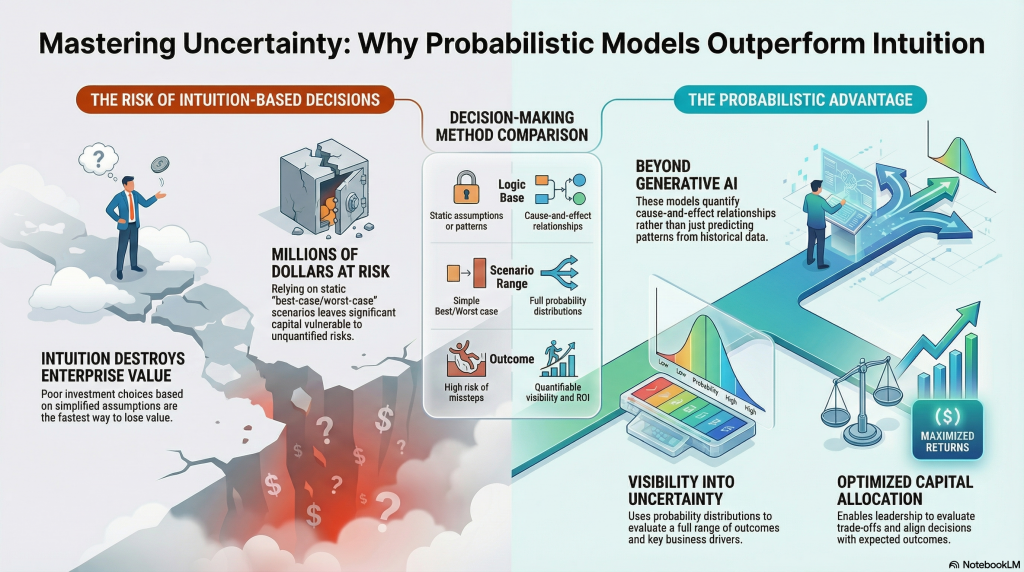
Yet most organizations still rely on simplified assumptions or intuition when allocating significant capital — often putting tens of millions at risk. When built correctly, probabilistic decision models change that. They enable leadership teams to quantify uncertainty, avoid costly missteps, and capture value that would otherwise be missed.
Why Decision Models Matter
At the core of effective transformation is the integration of probabilistic decision models that improve capital allocation and forecasting accuracy. These models enable leaders to evaluate trade-offs, optimize investment timing, and align decisions more closely with expected outcomes.
Execution requires discipline. Most organizations default to spreadsheet-based assumptions or judgment-driven approaches — not because the data is unavailable, but because combining data, operational insight, and structured modeling into something that reflects how the business actually performs is harder than it looks.
For example, a plant may evaluate a $10M automation investment to improve throughput and reduce labor costs. Initial analysis often assumes stable production volumes and immediate efficiency gains, resulting in an attractive projected ROI. When modeled probabilistically—incorporating variability in demand, implementation timing, workforce adoption, and maintenance performance—the distribution of outcomes widens significantly. In many cases, the model reveals that value is highly sensitive to utilization rates and changeover efficiency, factors not fully captured in the original analysis. This insight allows leadership to redesign the implementation plan and sequence investments more effectively.
Beyond Generative AI
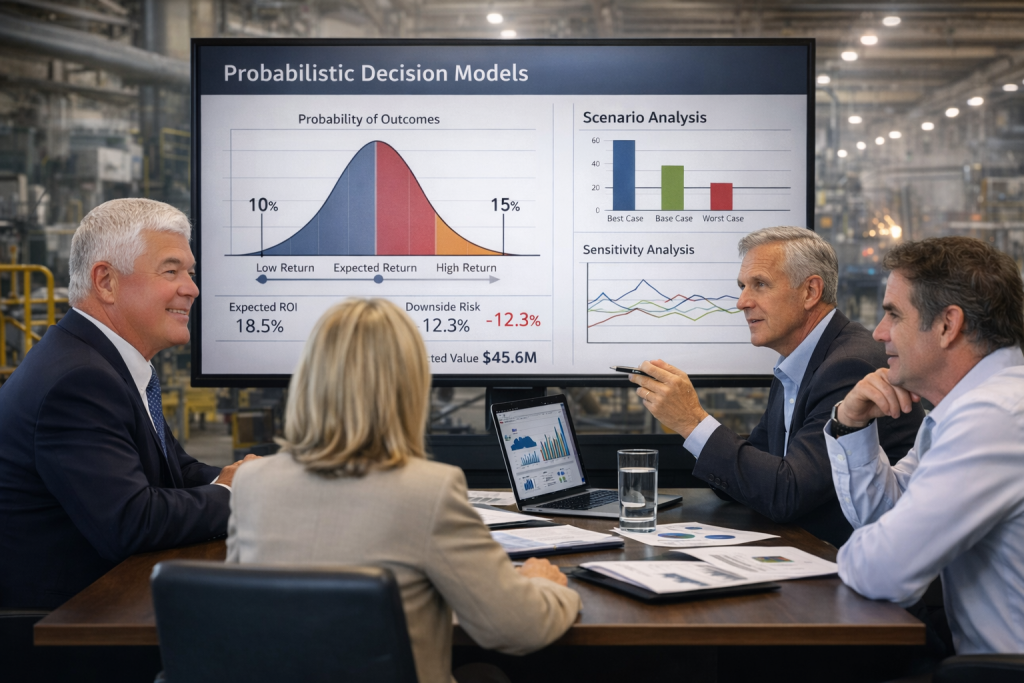
These models are fundamentally different from generative artificial intelligence. Unlike generative AI, which predicts or creates outputs from historical patterns, probabilistic decision models quantify cause-and-effect relationships to guide real-world business decisions under uncertainty. And, rather than relying on static “best-case/worst-case” scenarios, these models use probability distributions to evaluate a full range of outcomes and assess sensitivity to key business drivers.
Operational and Strategic Impact
When applied effectively, probabilistic decision models provide quantifiable visibility into risk, strengthen strategic alignment, and improve accountability for results. Leadership teams gain a more precise understanding of which variables matter most—and which actions will drive the greatest impact. In capital-intensive environments, this consistently translates into better investment outcomes and reduced downside risk.
What to Expect from Valverus
Executives who work with Valverus leave with more than a model — they leave with a clearer understanding of where their capital is most at risk, which variables actually drive return, and what it will take to protect and compound enterprise value. The result is faster, better-supported decisions and the analytical discipline to sustain that standard long after the engagement ends.
Executive Focus: Where to Prioritize
Priorities for senior leaders to consider:
- The cost of a poor capital allocation decision far exceeds the cost of modeling it correctly. For organizations making multi-million dollar investments, the case for probabilistic rigor is straightforward.
- Intuition and spreadsheets are not a substitute for probabilistic rigor. The gap between a projected ROI and actual return is almost always explained by variables that were assumed away at the start.
- The variables that matter most are usually the ones least examined. Utilization rates, implementation timing, and workforce adoption routinely determine whether a capital investment succeeds — and are rarely stress-tested in traditional analysis.
- Risk is quantifiable before you commit. Probabilistic modeling shifts the conversation from “what do we expect?” to “what is the full range of outcomes and what drives the difference?” — a fundamentally better basis for a capital decision.
- This is not generative AI. Executives evaluating their AI strategy should distinguish between tools that generate content and tools that model cause-and-effect under uncertainty. These serve different functions; both have value; conflating them leads to gaps in decision support.
Contact us today for an assessment of how we can help you create value.