

Interval and On-Time Delivery Improvement
Role: Lean Six Sigma (LSS) Leadership
Industry: Electronics Manufacturing
Situation
Production intervals were adversely impacted by inefficient processes and quality issues that caused significant re-work efforts. Current state performance was significantly affecting on-time delivery performance, customer satisfaction, and product line margins. The root causes and opportunities for improvement were unclear requiring an organized approach to re-engineering the production process.
Approach
Using the structured LSS DMAIC (Define, Measure, Analyze, Improve, Control) framework, we launched a cross-functional process re-engineering initiative to systematically remove bottlenecks, stream-line the process, improve quality, and reduce costs:
- Define & Measure: Mapped the end-to-end manufacturing flow using Value Stream Mapping (VSM) to isolate cycle time issues across a high-running product mix. Established a baseline average production interval of 42.5 hours with a standard deviation of 11.2 hours, revealing significant volatility. Established an average defect Cp value of 0.82 and a Cpk value of 0.51 for the process yielding high defect rates and high interval variation due to re-work cycles.
- Analyze: Standardized root cause data structures for Pareto Analysis to isolate the drivers of interval and variation spikes. Time studies identified that 76% of the lead time variance stemmed from material-picking durations and sub-assembly processing bottlenecks. ERP and MES lags and master data issues caused material picking delays. Sub-assembly bottlenecks were driven by solder accumulation and localized temperature drops in the wave soldering process resulting in widespread solder bridging with extensive rework, as well various other hand soldering deficiencies.
- Improve: Deployed re-engineered line, wave soldering, and IT processes including upgraded kitting requirements to compress cycle times and slash interval variation. We optimized line balancing based on Takt time to reduce variation, successfully compressing the average interval by 34% to 28.0 hours. By removing NVA steps and eliminating stop-and-go bullwhip effects, interval variation decreased by over 70%
- Control: Locked in the re-engineered line and process by revising Standard Operating Procedures (SOPs) and deploying interval-based control charts across all PNs, driving the future-state capability to a centered Cp value of 1.64 and Cpk value of 1.45. We re-trained operators and deployed Individuals and Moving Range (I-MR) Control Charts to enable Operations teams to monitor and react to process interval variations in real-time.
Results
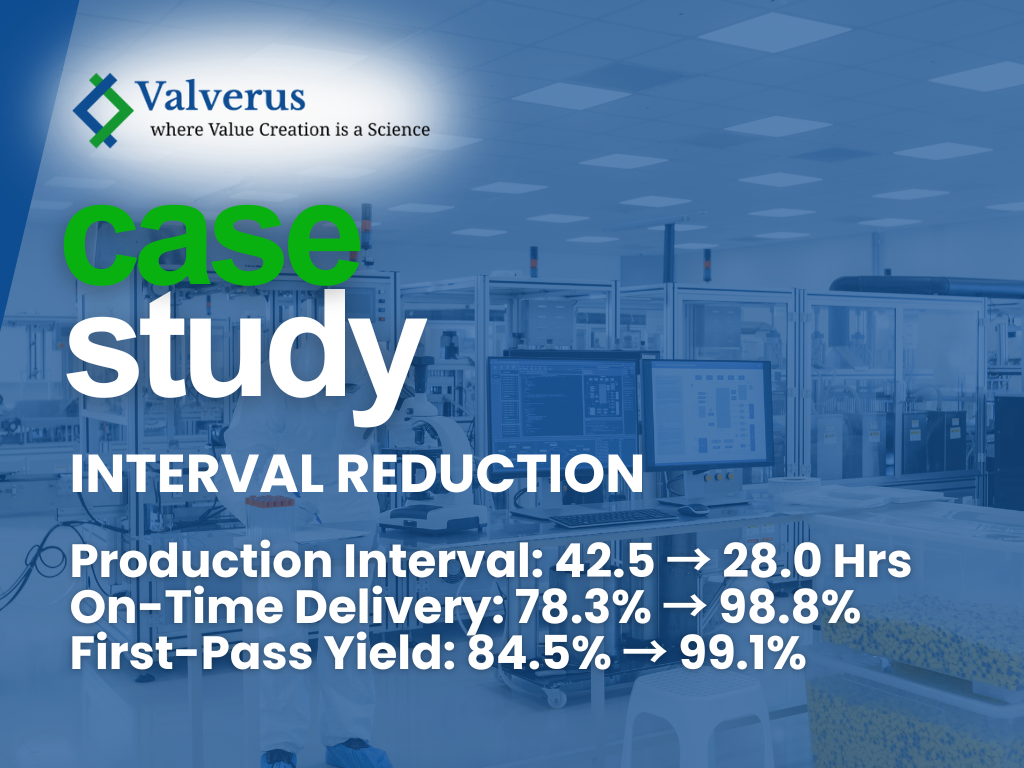
- Delivery (Interval & OTD): Reduced production intervals by 34% (42.5 to 28.0 hours) and variation by 70%, driving On-Time Delivery performance from 78.3% to 98.8%.
- Quality (FPY): Increased First-Pass Yield from 84.5% to 99.1% and improved Cp/Cpk values.
- Cost (Margin): Increased combined product line gross margin by 4.2%.
Additional Case Studies:
Case Study: How a LSS Process Re-Engineering Initiative Cut Production Intervals 34% and Drove On-Time Delivery to 98.8%