
The case for integrating Lean principles and AI to unlock returns of 3 to 10 times your original investment.
Automation Alone Does Not Guarantee Efficiency – Incorporating Lean Improvement With Automation Can Increase Returns Many Times Over
Many organizations invest heavily in robotics and automated systems expecting immediate gains in productivity and efficiency. While automation can dramatically improve performance, it does not inherently eliminate waste or inefficiency. In practice, companies often discover that automation simply embeds existing inefficiencies into faster, more expensive systems.
Automation can return big paybacks, but using Lean improvement in conjunction with the purchase of automation will solidify the highest returns of 3 to 10 times the original expectation. The real advantage comes from integrating automation with Lean principles—and increasingly, leveraging Artificial Intelligence (AI) to continuously refine and optimize performance.
At the core of high-performing automated systems are five design principles: flexibility, scalability, relocatability, replicability, remote programmability, and rapid repairability.
Flexibility
Production systems must adapt to changing products, volumes, and customer demand. While flexibility should be designed in from the outset, it requires more than strategic intent. Engineering teams should apply Lean disciplines—such as kaizen and value stream mapping—to embed flexibility into system design. The objective is simple but powerful: enable production lines to run any product, at any time, in any volume with minimal disruption.
However, automation kaizen is only half of the equation. True flexibility also depends on product and component design, requiring tight collaboration across manufacturing engineering, design engineering, and commercial teams.
Scalability
Scalability extends flexibility by addressing growth. Without Lean thinking, organizations often face disproportionate capital investments to achieve incremental output gains.
Lean principles enable systems to scale incrementally and efficiently, much like adding labor capacity to a manual line—but with significantly higher returns. The goal is to increase throughput without linear increases in capital spend.
Relocatability & Duplicability
As product mix and market dynamics shift, automated assets must move with the business. Robotics and automation should be designed for rapid redeployment across lines or facilities.
Applying Lean innovation principles during design ensures that equipment remains a strategic, mobile asset rather than a fixed constraint.
Remote Programmibility
Modern automated systems must support remote programming, monitoring, and diagnostics. These capabilities allow engineering teams to respond quickly, reduce downtime, and continuously optimize performance.
As systems evolve and customization increases, maintaining these capabilities is critical to preserving long-term asset value and responsiveness.
Rapid Repairability
Automated systems must be designed for fast diagnosis and repair. As complexity increases, unplanned downtime becomes more costly and more difficult to resolve. Using lean principles to create standard platforms for robotics not only enables replicability but also enables fast repair, and helps with total preventive maintenance.
Applying Lean principles to the design and procurement of automation to get rapid repair is how a production operation can avoid excessive downtime.
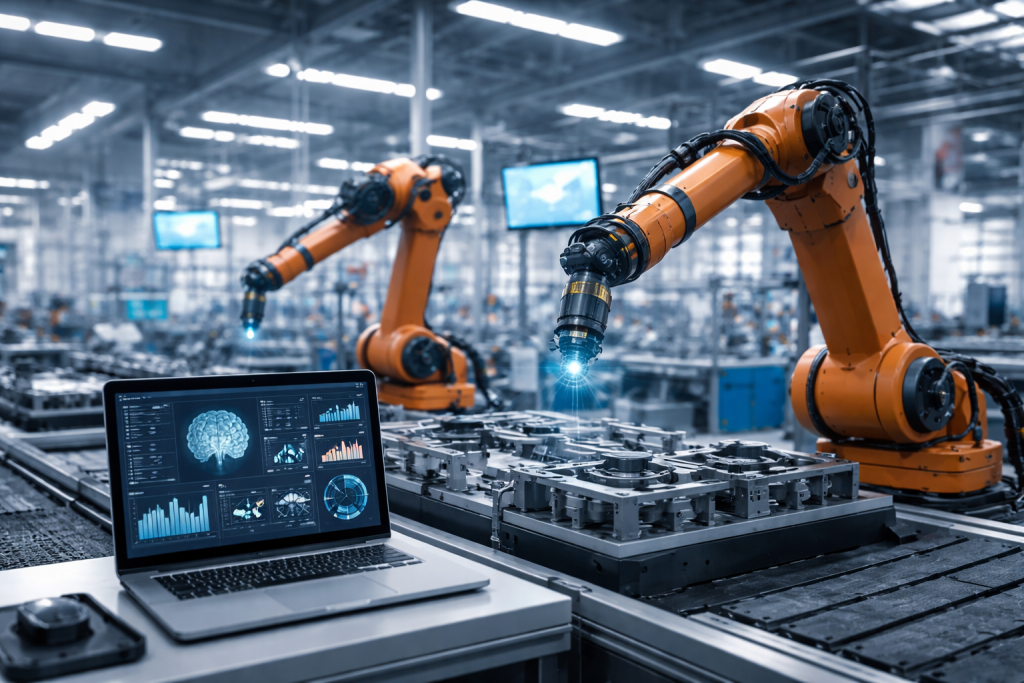
Applying Lean in Automated Environments
The core Lean principles remain highly relevant:
- Kaizen
Small, continuous improvements drive significant gains in automated systems—optimizing robot paths, simplifying programming, and reducing cycle variability. And of course, waste removal and robotic feature optimization. - Process Flow Mapping
Using lean techniques to find bottlenecks, excess inventory/excess buffer, wasted wait time, unbalanced throughput, etc. - Structured Idea Generation
A subset of a kaizen culture, idea generation techniques are fundamental to finding new ways of reducing waste, creating replicability, and enabling benefits of scale. - SMED (Single-Minute Exchange of Dies)
SMED is more than it was 30 years ago . SMED has evolved beyond its origins as a manual, Toyota-centric tool-change method into a more data-driven, design-oriented approach that enables flexible, high-variability production. In regards to robots, it represents a frame of mind to find ways to quickly “plug and play” system expansion.
The Principles Remain the Same
Manual Production
- Operator cycle analysis
- Workstation balancing
- Ergonomic improvement
Setup reduction
Automated Production
- Robot cycle analysis
- Cell throughput balancing and pre-designated rebalance designs
- Robot path optimization enhanced by AI
- Automated changeover optimization with designed-in features
Regardless of technology, the fundamental improvement logic does not change—only the tools evolve and “thinking with doing” is essential.
Your Role as a Leader
Automation does not reduce the need for human insight—it increases it. The most successful organizations recognize that technology alone is not a competitive advantage; how it is deployed and continuously improved is what differentiates performance.
High-performing companies consistently invest in:
- Cross-functional collaboration across engineering, operations, and maintenance
- Structured, data-driven problem solving
- A culture that prioritizes continuous improvement
Automation delivers its full value only when leadership ensures that people remain actively engaged in improving the system.
The Role of Valverus
For many organizations, the challenge is not understanding these principles—it is executing them at speed and scale.
Valverus partners with leadership teams to bridge the gap between current performance and best-in-class operations by combining Lean expertise, practical AI application, and hands-on execution support. From diagnosing inefficiencies embedded in automated systems to implementing scalable, flexible solutions, Valverus enables organizations to unlock step-change improvements in productivity, cost, and profitability. For CEOs seeking measurable results—not just strategy—Valverus serves as a trusted partner in driving sustainable operational transformation.
Executive Focus: Where to Prioritize
To realize full return on automation investments, leadership teams should prioritize:
- Designing systems for flexibility and scalability to adapt to changing products, volumes, and demand
- Applying Lean principles early to eliminate waste and improve flow before automating processes
- Ensuring automation assets can be redeployed and adapted as business needs evolve
Contact us today for an assessment of how we can help you create value.