
by Wolfgang Rauchholz, Client Solutions Executive
A Study in Classic Execution vs AI-Enabled Execution
Sales, Inventory, & Operations Planning (SI&OP) is a management operating system, not just a planning tool.
Key Insights: AI reduces manual effort, and can accelerate insights and results, but does not replace needed leadership and accountability.
Why This Initiative Was Deployed
Operational pain had become impossible to ignore. Inventory turns were more than 20 percent below reliable benchmarks for a global industrial player. Express and premium freight exceeded 800k USD annually and kept rising. Service levels hovered below 85 percent despite significant effort. Email traffic and conference calls replaced planning. Firefighting became the default operating mode. There was no formal SI&OP process, only fragmented planning activities.
Local fixes failed because the problems were systemic. Planning tried to improve forecasting. Logistics negotiated improved freight rates. Sales pushed for more inventory “just in case.” Finance reacted after the fact. Each function optimized locally and degraded the system globally.
Leadership needed a process to align decisions across demand, supply, and finance—not just another report or tool, but a management operating system that forced trade-off decisions at the right time with the right information.
The project described here was executed without AI. Data was extracted manually. Analysis lived in spreadsheets. Alignment required repetition, discipline, and time. The fundamentals that made it work have not changed. What has changed is how fast insight can be generated and how much manual effort can be removed.


Phase 1: Identification of the Need
How it was done prior to AI
The first step was brutally simple and painfully slow. Data had to be pulled from multiple systems, ERP, warehouse management, finance, and sales tools. Numbers did not reconcile. Each function trusted its own version. Weeks were spent aligning definitions before discussing outcomes.
Inventory turns were calculated manually by product family. Freight spend was dissected line by line to isolate expedites. Service levels were rebuilt order by order to separate customer issues from internal failures. Most meetings were spent arguing about numbers, not decisions.
This effort mattered as it created credibility. Leaders could not dismiss the findings as anecdotal. The pain was quantified and traceable.
How AI would support this phase today
AI would compress this phase dramatically. Pattern detection across SKUs, lanes, and customers would surface root causes faster. Anomalies would be flagged earlier. Signal could be separated from noise without weeks of manual slicing.
Highlighting that an inventory level is high is not the same as deciding whether to protect service, free cash, or stabilize operations. Priorities remain a leadership call but with improved insights.
Phase 2: Verifying a Shared Need and Painting a Vision
How alignment was achieved prior to AI
Data alone did not create alignment. Storytelling did.
Workshops were run with senior leaders and functional heads. The same story was told repeatedly. Poor service was not a logistics problem. Excess inventory was not a planning failure. Expediting was not a carrier issue. All were symptoms of disconnected decision-making.
The vision was simple. One integrated monthly cycle. One set of numbers. Clear decision points. Explicit trade-offs between service, cost, and inventory. No surprises at the end of the month.
The vision had to be repeated until the repetition built trust.
How AI could support this today
AI would help visualize the future state faster. Scenarios could be simulated in minutes instead of weeks. Leaders could see the impact of different policies on cash, service, and capacity in real time.
Leadership still owns the narrative, as AI does not create vision. Algorithms support but do not necessarily decide what level of service the business is willing to pay for.
Phase 3: Stakeholder Alignment
Classic resistance points
Resistance followed a familiar pattern. Sales feared loss of flexibility. Operations feared exposure. Finance feared losing control of numbers. Middle management feared transparency.
Alignment was built through cadence and visibility. The same data was used in every forum. Issues were escalated, not hidden. Decisions were documented and revisited.
Trust mattered – people came to understand the process would protect the business, not punish individuals.
How AI helps today
AI can reduce friction. Shared dashboards with real-time analytics and simulation capabilities replace offline spreadsheets. A single source of truth reduces debates about whose numbers are right. Preparation time drops sharply.
AI does not resolve all conflicts. When sales and supply disagree on priorities, that tension still requires a decision. AI can make the options clearer and the disagreement visible sooner for faster action.
Phase 4: Pulling the Team and Agreeing on Scope
How the team was formed
The core team was deliberately small; senior enough for decision-making and close enough to the data to understand consequences.
Scope discipline was critical at first. SI&OP activities were limited to material product families vs. SKU levels. Marketing initiatives and new product introductions were excluded initially to be phased in later.
The exclusions allowed focus in order to build momentum.
How AI changes this today
With AI handling much of the data preparation, core teams can be smaller and launch faster. Less time is spent on compiling numbers with more time on managing exceptions.
Scope and discipline remain essential. AI increases the ability to include more considerations and variables but it is still recommended to limit focus while developing a disciplined process.
Phase 5: Project Execution
Governance and cadence
Execution followed a classic project structure including clear milestones, weekly core team meetings, monthly steering committee reviews, and time-bound escalations.
Momentum was protected by sponsorship visibility. Missed deadlines were addressed immediately and decisions were not deferred to avoid discomfort.
AI support today
Automated data acquisition and analysis shortens cycle times. Scenario reviews happen more frequently and simulations that once required days can be reviewed in minutes.
Governance remains non-negotiable in a high performing process. Faster insights are rendered ineffective without decision discipline.
Phase 6: SI&OP Process Implementation
The classic cycle
The cycle followed a standard structure:
Demand review focused on assumptions, not just forecasts, while Supply review exposed constraints and options. The pre-SI&OP meetings reconciled gaps. The resulting executive SI&OP meeting was a decision forum, not a reporting meeting.
Every decision had an owner and deviations resulted in actions.
AI-enhanced execution today
AI improves signal quality. Demand sensing refines short-term outlooks. Scenario comparison becomes faster and more robust with sensitivity views. Constraint-aware planning surfaces trade-offs much earlier than in the past.
Phase 7: Results and Impact
Results achieved prior to AI
The outcomes were measurable:
Inventory turns improved by 15 to 20 percent within twelve months. Express and premium freight was reduced by more than 40 percent. Service levels stabilized above 95 percent. Firefighting declined sharply. Email traffic dropped. Meetings became shorter and decision-oriented.
The most important result was behavioral; teams and leaders stopped negotiating in isolation. Trade-offs moved into the SI&OP process and forums.
What AI would improve today
Time to insight would be shorter. Corrective actions would happen earlier. Risks would be identified sooner, especially around demand volatility and supply disruption.
AI can accelerate process maturity and drive beneficial results for the business.
What Has Not Changed
SI&OP success still depends on leadership sponsorship, decision discipline, and cross-functional accountability.
AI accelerates insight. It improves signal quality. It removes manual effort. It does not replace governance. It does not remove the need to choose. It does not enforce accountability.
Tool-first SI&OP implementations fail for the same reason they always have. They confuse visibility with control and data with decisions.
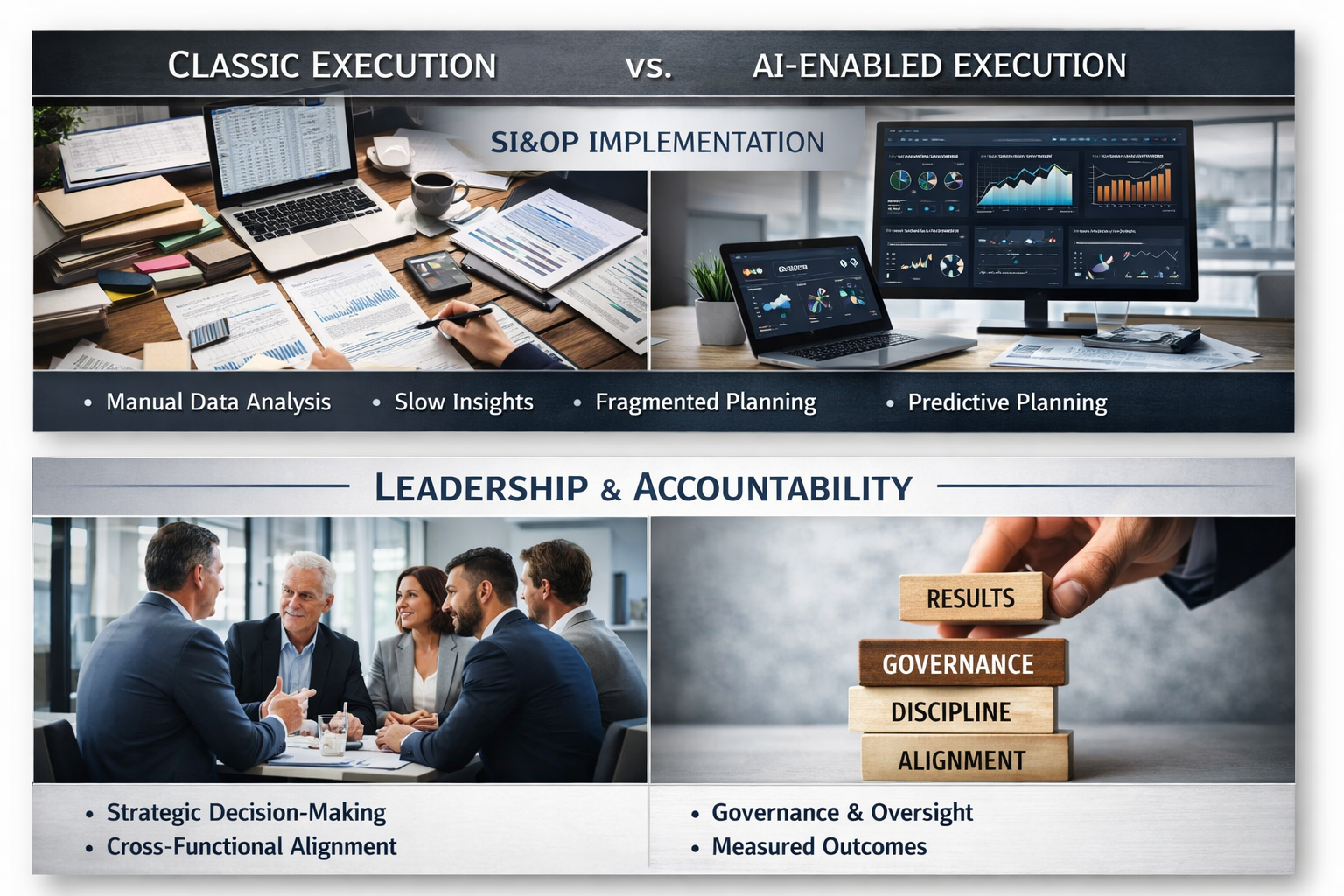
Then vs Now, Summary Comparison
| Aspect | Classic Execution | AI-Enabled Execution |
| Data preparation | Manual, slow | Automated, fast |
| Scenario analysis | Limited | Extensive |
| Decision cadence | Monthly | Monthly, with faster insight |
| Leadership role | Central | Still central |
| Accountability | Human | Human |
Five Executive Takeaways
- SI&OP is a management system, not a forecast process.
- AI improves speed and insight, not accountability.
- Governance and cadence are critical.
- Focus and discipline determine success.
- AI can accelerate results in a disciplined SI&OP process.
Contact us today for an assessment of how we can help you create value.